
Chronoliths
some quick notes on theoretical orientations

I’m not sure the world of contemporary art—in any discipline—needs more words mashed together in an effort to articulate ‘a theoretical position’ for the work. My Chronoliths project in exhibition has no such positioning at all. For a reason. The work’s ambiguous forms and deliberate material anachronisms—contemporary stoneware objects, engraved with some of the oldest known symbols of humankind, as well as the use of a Paleolithic blade for their creation—invite interpretation, sure, but more intriguingly for me, encounter. Theory might be helpful for interpretation, but it offers nothing for encounter.
These few hundred words are more for me, and those interested from a curatorial or editorial perspective, to help articulate some of the thinking behind the project in studio.
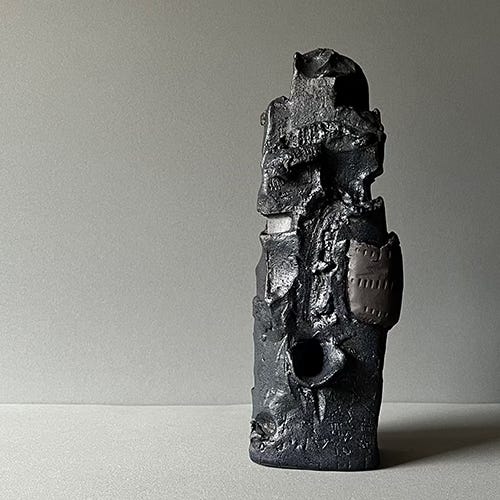
At the heart of Chronoliths lies a phenomenological impulse, closely aligned with the work of Maurice Merleau-Ponty. His concept of pre-reflective perception—the idea that meaning emerges not through intellectual analysis but through bodily engagement—is one that I’ve found useful for thinking about a viewer’s relationship to the chronoliths. In Phenomenology of Perception, he argues that perception is not a passive reception of information but an action of being in the world. The chronoliths, in their silence and strangeness, do not signify in any conventional sense; rather, they solicit a form of attentiveness that is felt before it is even noticed. Anyone walking through the fields of stones in Carnac knows this sort of attentiveness, and I’d like to think that it is mirrored in a more intimate way with the chronoliths.
Georges Didi-Huberman’s reflections on image, trace, and historical opacity can be useful to understanding Chronoliths’ ingrained resistance to legibility. In Confronting Images and The Surviving Image, he critiques the positivist imperative to extract fixed meaning from the past. Instead, he champions a poetics of the fragment, where ambiguity is not a deficiency but a necessary condition of any encounter with the past. The chronoliths, situated deliberately within this ambiguous terrain, do not offer themselves as evidence of lost meaning but as invitations to linger (and sometimes squirm) in its absence. They operate, to borrow his language, as “survivals”—presences rather than decipherable messages.
Anthropologist Tim Ingold provides a framework for understanding the role of making in Chronoliths as an epistemic act, and how that in turn shapes its power. In his Making: Anthropology, Archaeology, Art and Architecture, he proposes the idea that the act of crafting is not the application of form to matter but a dialogue with materials. The use of that Palaeolithic blade in the creation of the chronoliths literalizes this proposition: the gesture of making incorporates the contemporary body of clay and effort into a 100,000 year old lineage. This collapse of time, engendered not by representation but through action, places Chronoliths in continuity with ancient acts of inscription whose meanings were never stable to begin with. And, in so doing, creates a sort of familiarity (strange as it may be) in the viewer.
In The Politics of Aesthetics, Jacques Rancière reframes aesthetics as the “distribution of the sensible”—the organization of what is visible, sayable, and thinkable within a given regime. Ambiguity becomes a kind of political gesture: it unsettles existing distributions and demands new modes of attention. Chronoliths, in refusing explanatory text or narrative certainty, redistributes interpretive labor to the viewer where to my mind, it ought to be. It reconfigures the viewer from passive recipient to active participant.
Carlo Severi’s work on ritual and memory compliments and deepens this perspective. In The Chimera Principle, he explores how ritual images—especially those in oral cultures—function not by transmitting meaning directly but by enabling processes of imagination and memory. These images are ambiguous by design, structured to provoke those processes rather than explain a set meaning. The chronoliths, with their indecipherable symbols and suspect provenance, work in precisely this way: not as texts to be read but as objects that catalyze speculation, projection, and the invention of narrative worlds.
Chronoliths in exhibition does not merely represent deep time; rather, I’ve designed it as an event that draws viewers into it. It challenges the assumption that meaning must be extracted from the past and instead foregrounds our desire to interpret as the real subject.
The silence of the objects is a field of potential. It is a project—like some others I’m working on—about the conditions of knowing, and the strange fertility of not knowing.
Chronoliths is a collection of eight stoneware pieces, inscribed with humanity’s oldest known collection of symbols, created in part with a paleolithic blade. These ceramics are accompanied by a small collection of archival materials that complicate interpretive impulses. In preparation for their first exhibition as a full collection, little material is publicly available. As we get closer to their release, you’ll be able to find images, etc at chronoliths.com.